Why Every AI Coding Demo Looks Like the Same App
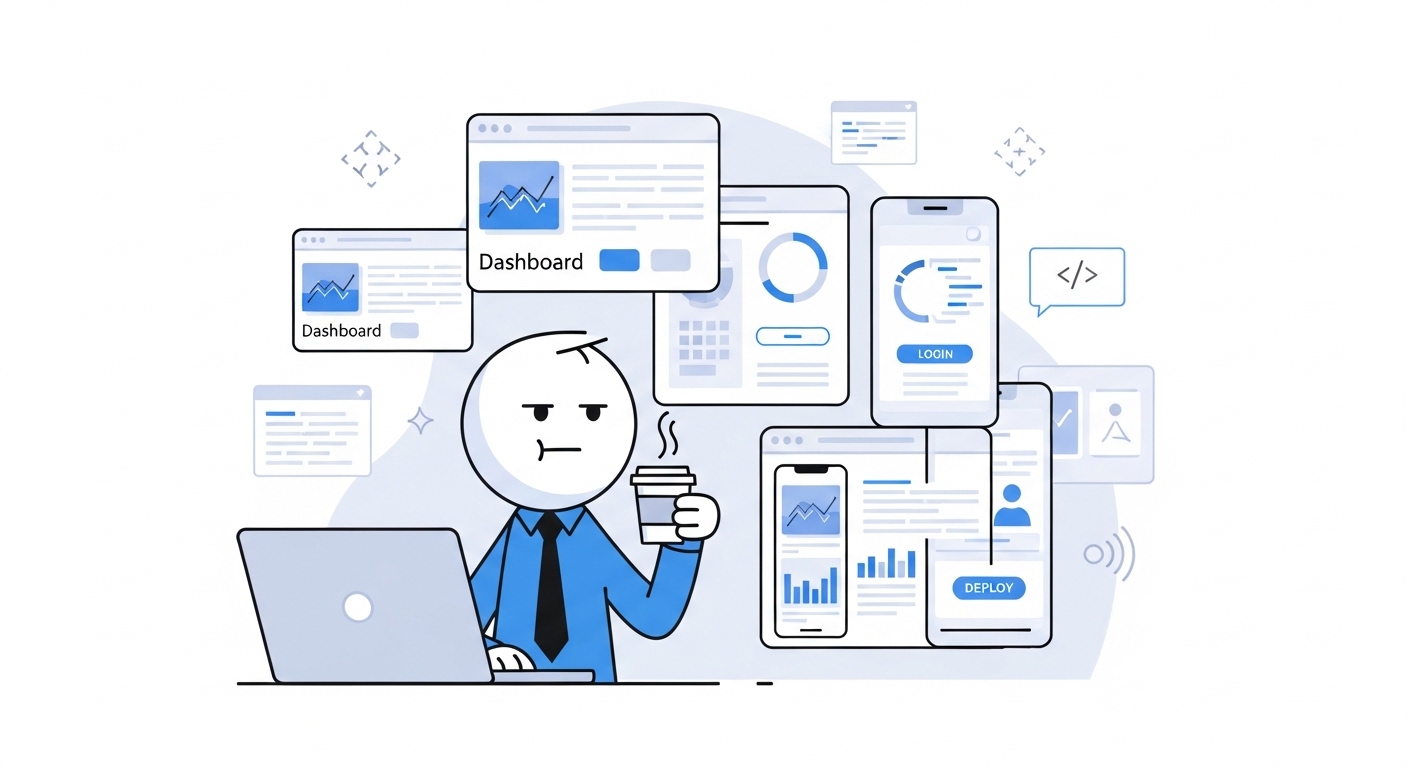
Scroll through social media for a few minutes and you will start noticing a pattern.
Most AI coding demos look almost exactly the same.
It is usually a website, a dashboard, or a mobile app. Maybe it has a login page. Maybe it connects to Stripe. Maybe it pulls data from an API and adds a clean UI with Tailwind. Then it gets deployed with one click and presented like a breakthrough.
From the outside, it can feel impressive. But if you have been building software for a while, the pattern is hard to miss. A lot of these demos are not showing the full range of programming. They are showing one very specific category of software, repeated over and over again.
That is the part many non-developers do not see clearly.
AI Did Not Learn Programming the Way Developers Do
P A lot of the current hype makes it sound like AI deeply understands software the same way an experienced engineer does. In reality, what it does best often comes from exposure to massive amounts of familiar code patterns.
And where do those patterns exist in the largest volume?
On the web.
The internet is full of tutorials about building SaaS products, creating dashboards, making landing pages, wiring up authentication, styling components, and connecting APIs. There are endless code examples, blog posts, GitHub repos, YouTube walkthroughs, and Stack Overflow answers showing the same workflows again and again.
Create a Next.js app. Add Tailwind. Build some UI. Fetch data. Hook up payments. Deploy.
These patterns are everywhere. So naturally, AI becomes good at reproducing them.
That does not mean it invented a new way to build software. In many cases, it is simply predicting the most likely next step based on what it has seen thousands of times before.
Why Web Apps Are the Perfect Environment for AI
Web and mobile apps give AI something it handles well: repetition.
They usually follow familiar structures. There is a frontend, a backend, a database, a few integrations, and a deployment flow. Even when the execution is messy, the overall shape is predictable.
That matters a lot.
AI performs best when the path is well-worn. If the project looks like something it has seen repeatedly across public code and tutorials, it can move fast. It can assemble working pieces, borrow common patterns, and produce something that looks polished enough for a demo.
This is why so many AI-generated projects feel similar. They live inside a comfortable zone where the rules are visible and the examples are everywhere.
And to be fair, that still has value. Rapid prototypes matter. Fast iteration matters. Shipping an early concept matters.
But we should not confuse success in a familiar environment with mastery of software engineering as a whole.
The Moment Things Get Hard, the Illusion Breaks
Ask AI to build a landing page, admin panel, or basic app flow, and it often looks capable.
Ask it to build a compiler, a browser engine, a database, an operating system component, or performance-critical infrastructure, and the story changes quickly.
That is where the confidence usually drops.
These kinds of systems are harder because they demand precision, deeper reasoning, and a much smaller tolerance for failure. A web app can often survive with rough edges. A quirky UI or imperfect data flow might still be acceptable for a demo. In some cases, a product can be janky and still look good enough in a short video.
A compiler does not get that luxury.
A database cannot be “mostly correct.”
A kernel bug is not charming.
In systems programming, low-level mistakes are expensive. Memory handling, concurrency, performance, and correctness matter in ways that cannot be hidden behind animations or nice UI.
And unlike web development, there are fewer beginner-friendly examples for AI to remix. There are fewer tutorials, fewer copy-paste patterns, and fewer forgiving environments.
That is why AI often looks smooth in one area and noticeably weaker in another.
Why Developers Are Less Impressed by Viral Demos
This difference is one reason experienced developers often react differently to AI demos than the general public.
Non-developers may see a polished app and think, “This is incredible. AI can build anything now.”
Developers usually see the hidden fragility.
They know the login flow might break. They know the data layer may be shaky. They know the happy path was probably tested more carefully than everything else. They know that a clean demo is not the same as a durable system.
That skepticism is not negativity. It is context.
When you have spent enough time fixing production issues, dealing with bad state management, untangling broken integrations, or debugging edge cases, you learn that software quality is not measured by how good a short demo looks.
A lot of viral AI projects are optimized for speed, novelty, and presentation. They are built to get attention quickly. That is very different from building software that survives real usage.
AI’s Strength Also Reveals Where the Opportunity Still Is
The interesting part is not just that AI is good at web apps.
It is that this strength tells us where human skill still matters most.
If AI is heavily concentrated around familiar app-building patterns, then other areas remain harder, less crowded, and more valuable.
That includes:
Systems Programming
Low-level programming still demands careful thought. Bugs are harder to detect, harder to fix, and less forgiving. You cannot rely on surface-level polish when correctness is the actual product.
Performance-Critical Software
Some applications cannot solve problems by throwing more hardware at them. Efficiency matters. Latency matters. Memory usage matters. That work still requires strong engineering judgment.
Infrastructure and Platform Engineering
Distributed systems, networking, observability, deployment architecture, and reliability engineering are not “vibe coding” friendly. These areas involve tradeoffs that go beyond assembling familiar templates.
Deep Technical Products
Anything that requires strong domain knowledge, original architecture, or careful reasoning is still difficult to automate well.
That is worth paying attention to.
Because while many people are chasing fast AI-generated apps, there is still a lot of room in the parts of software that remain difficult to fake.
The Real Picture Behind the Hype
So why do so many AI coding demos look the same?
Because they come from the same environment, the same patterns, and the same kind of training exposure.
AI is strongest where software development is already highly repetitive, well-documented, and easy to imitate. That is why we keep seeing the same kinds of projects: dashboards, CRUD tools, landing pages, mobile app shells, and basic SaaS clones.
It is not random.
It is a reflection of what AI has the most practice with.
That does not make the tools useless. It just means we should describe their strengths honestly.
Yes, AI can help people build software faster.
Yes, it lowers the barrier for prototyping.
Yes, it can be genuinely useful.
But no, that does not mean it has solved every layer of programming equally.
Under much of the hype, the reality is simpler than people want to admit:
AI is very good at producing one specific slice of software, and that slice is still mostly the web.
Closing Thought
Anyone can be impressed by a flashy demo.
The more useful question is: what kind of software is actually being built?
If nearly every viral example ends up being another web or mobile app, that tells us something important. It shows where AI feels comfortable. It also shows where real engineering is still hard, still rare, and still valuable.
And that is probably the most honest way to look at the current moment.
The future of software will not be defined only by who can generate the fastest demo. It will be shaped by who can build systems that still hold up when the demo ends.