The AI Adoption Trap: Why Companies Are Measuring the Wrong Thing
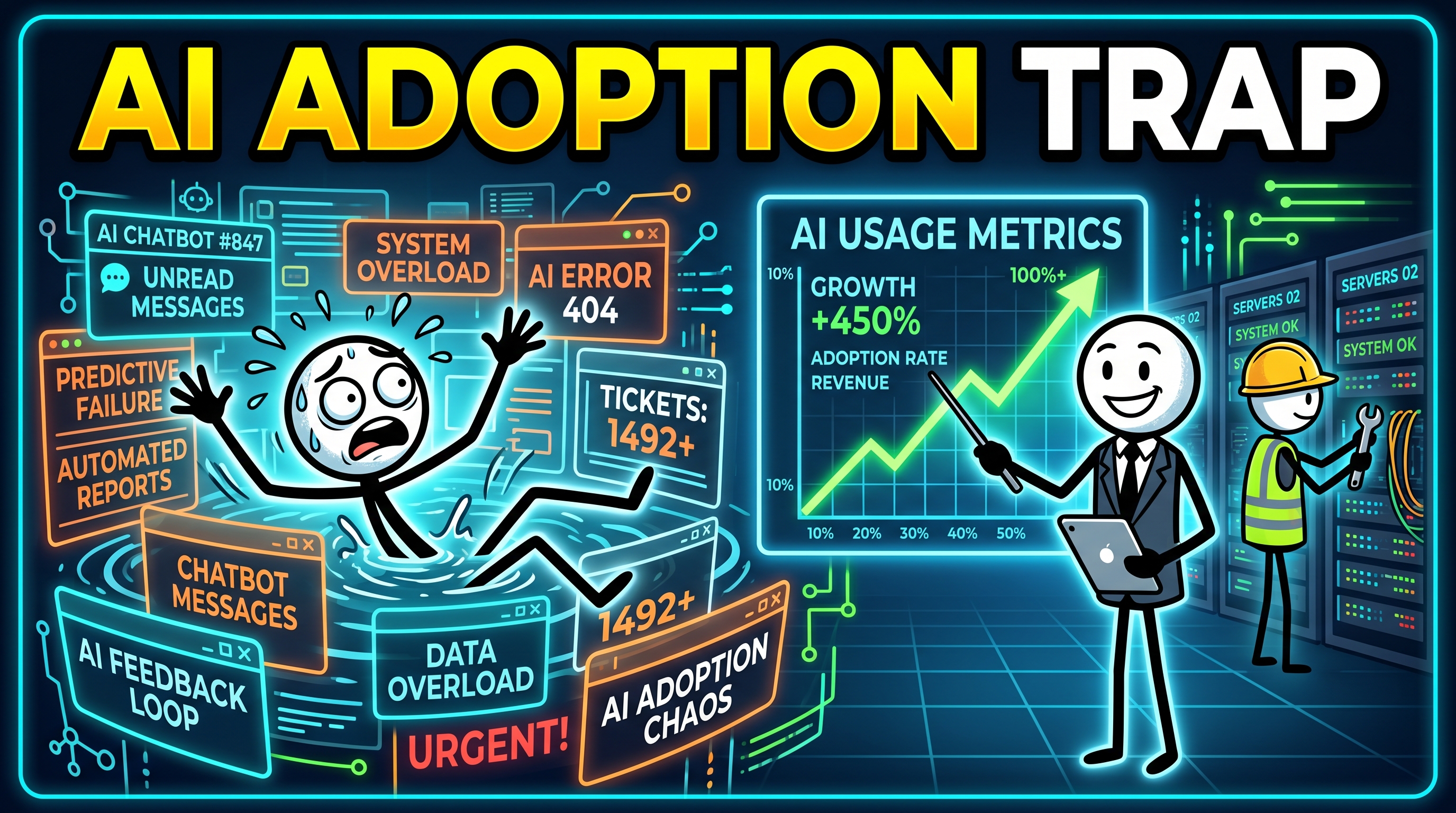
For the past two years, the tech industry has been repeating the same message: AI is replacing developers, AI agents will automate entire companies, and software is becoming almost free.
That narrative spread fast.
Suddenly, every company needed an AI strategy. Executives rushed to tell investors how much AI their teams were using. Employees were encouraged — and sometimes pressured — to integrate AI into their daily work. In some organizations, workers even had to meet internal AI usage quotas.
But this created a strange new problem.
Instead of focusing on building better products, many employees started focusing on looking productive with AI.
There’s even a term for it now: “token maxing.”
When Metrics Become the Goal
This situation reflects an old economic principle known as Goodhart’s Law:
“When a measure becomes a target, it stops being a good measure.”
You can see this pattern everywhere.
If customer support teams are judged only by how fast they close tickets, they stop focusing on solving problems. They rush customers off the phone to improve the numbers. The metrics look great, but the service becomes worse.
The same thing is now happening with AI adoption inside tech companies.
According to reports from the Financial Times, companies like Amazon encouraged developers to use AI coding tools regularly so leadership could show investors strong AI adoption numbers. Some reports claimed teams were expected to hit high percentages of AI-assisted work each week.
Once AI usage became tied to performance reviews and management expectations, the incentive changed completely.
Developers stopped asking:
- “Does this improve the software?”
- “Does this make the system more reliable?”
- “Is this actually useful?”
Instead, the focus became:
- “How can I increase my AI usage metrics?”
- “How can I show more token activity?”
- “How do I look productive internally?”
That’s the dangerous part.
Companies bought AI tools to save time, but some employees ended up wasting time creating unnecessary AI workflows just to satisfy management dashboards.
AI Is Useful — But It’s Not Magic
To be clear, AI tools are genuinely useful.
They can help developers:
- write boilerplate code,
- summarize documentation,
- automate repetitive tasks,
- speed up debugging,
- and improve productivity in many situations.
But many executives started treating AI like an all-knowing system instead of a tool.
That’s where problems begin.
Software engineering is not simply about generating code faster. Real engineering involves:
- system architecture,
- security,
- infrastructure,
- scalability,
- maintenance,
- testing,
- and long-term reliability.
AI can generate code that looks correct. That does not mean the code is safe, scalable, or production-ready.
And that distinction matters a lot.
The Hidden Cost of Blind Automation
Reports from major tech companies have already shown cases where AI-assisted systems contributed to operational problems and downtime incidents.
When systems fail at 2:00 a.m., companies do not rely on another AI agent to solve everything automatically.
They call experienced engineers.
That’s the irony many people ignore.
The more companies automate coding, the more valuable senior engineers become — because someone still needs to:
- review architecture,
- verify security,
- audit systems,
- debug failures,
- and understand how everything connects together.
Generating code is easy.
Building reliable systems is hard.
Those are completely different skills.
The Internet Is Starting to Feel the Pressure Too
The impact goes beyond software teams.
A growing amount of internet traffic now comes from AI agents scraping websites, summarizing content, and interacting with other automated systems. In response, many websites are beginning to block or restrict automated traffic.
At the same time, companies continue racing toward full automation before the infrastructure, governance, and trust systems are fully prepared.
This creates what many people are now calling the agentic trap.
Blind automation does not remove complexity.
It simply postpones the problem and transforms it into technical debt.
And often, the delayed problems become even harder to solve because the systems are now:
- harder to debug,
- harder to secure,
- harder to maintain,
- and more dependent on automation nobody fully understands.
The Companies Winning With AI Are Doing Something Different
The companies seeing real value from AI are usually taking a much simpler approach.
Instead of chasing AI metrics, they focus on actual business outcomes.
They:
- start with real problems,
- measure improvements in productivity and quality,
- use AI where it genuinely helps,
- and treat AI as an assistant — not a replacement for human thinking.
That approach creates sustainable results.
Because in the end, businesses are paid to create value for customers, not to generate AI activity statistics.
And right now, many companies are confusing those two things.
Final Thoughts
AI is one of the most powerful tools the tech industry has ever created. It will absolutely change how software is built and how businesses operate.
But a tool is not a strategy.
Forcing AI adoption through quotas, dashboards, and performance metrics creates bad incentives. It encourages people to optimize for appearances instead of outcomes.
The real future of AI will not belong to the companies that use it the most.
It will belong to the companies that use it intelligently.