Rust Didn't Take Over Programming. It Split the Industry Instead
When Cloudflare replaced parts of its NGINX-based infrastructure with a Rust-powered proxy, the numbers were difficult to ignore. CPU usage reportedly dropped by around 70%, while memory consumption fell by more than half under production traffic measured in trillions of requests per day. At that scale, performance improvements are no longer technical curiosities. They become balance sheet decisions.
This is the part many developers miss when discussing Rust adoption. Large companies are not moving toward Rust because it feels modern or because developers enjoy ownership semantics. They are moving because infrastructure efficiency directly affects operating costs, security exposure, and hardware spending.
The economics changed.
For years, C and C++ remained the default choice for systems programming because they delivered raw performance with predictable overhead. The tradeoff was memory safety. That compromise powered operating systems, databases, browsers, game engines, and networking infrastructure for decades, but it also created an endless stream of vulnerabilities tied to buffer overflows, dangling pointers, and use-after-free bugs.
Microsoft’s internal security research showed that a large percentage of critical vulnerabilities in Windows originated from memory corruption issues. Rust attacks that category of problems directly at compile time. The language forces developers to prove memory safety before software ever runs in production.
That changes the equation for companies operating at enormous scale.
The Rust compiler is notoriously strict, but in infrastructure software, that strictness often saves money later. A difficult compiler is cheaper than a security incident. Long compile times are cheaper than downtime. Refactoring complexity is cheaper than maintaining fleets of unstable services that burn hardware resources around the clock.
This is why the conversation around Rust increasingly sounds less like developer preference and more like policy. Microsoft has pushed Rust into parts of the Windows ecosystem. The Linux kernel accepted Rust support after years of resistance. Government cybersecurity guidance has also started discouraging unsafe memory practices in new software projects.
Once organizations at that level standardize around a toolchain, developers naturally begin assuming the language represents the future of all software development.
That assumption is where the story becomes more complicated.
Rust Excels at Infrastructure Problems
Rust shines when software is operating close to hardware limits or when reliability failures become financially dangerous.
Discord experienced this firsthand while dealing with latency instability caused by garbage collection behavior in performance-sensitive backend systems. After rewriting critical components in Rust, they eliminated unpredictable latency spikes and achieved more stable response times under load.
That kind of improvement matters for real-time systems. A few milliseconds of inconsistency can ripple across millions of users.
The same pattern appears across the broader tooling ecosystem. Many of the fastest-growing developer tools today are written in Rust, especially replacements for older Unix utilities or slow Python tooling. Modern package managers, formatters, and linters built in Rust routinely outperform their predecessors by massive margins.
The reason adoption happened so quickly is simple: developers immediately felt the speed difference.
Nobody needs a philosophical argument after watching a tool go from 15 seconds to 200 milliseconds.
AI companies noticed this as well. Fast tooling compounds productivity across large engineering teams, especially when builds, formatting, dependency resolution, and code analysis run constantly throughout the day.
Rust has quietly become part of the performance layer beneath modern development workflows.
The ecosystem has also matured far beyond command-line utilities.
Today, developers can build high-performance web backends using frameworks like Axum alongside async database layers such as SQLx. Rust compiles to WebAssembly efficiently, allowing teams to move expensive browser-side computations out of JavaScript. Embedded developers use async runtimes like Embassy for microcontroller firmware, while game developers increasingly experiment with engines like Bevy for simulation-heavy projects.
Technically, Rust is now capable of serving almost every layer of the stack.
But capability and practicality are not the same thing.
The Adoption Curve Hides an Important Reality
Rust consistently ranks as one of the most admired programming languages in developer surveys. Yet admiration does not automatically translate into long-term usage.
A surprisingly large percentage of developers experiment with Rust and eventually return to other languages for day-to-day work.
That pattern reveals something important about where Rust actually fits.
In infrastructure-heavy environments, the tradeoffs make sense. A company running globally distributed systems can justify slower iteration speed if the result is lower hardware costs, fewer outages, and stronger security guarantees. The engineering economics work in Rust’s favor.
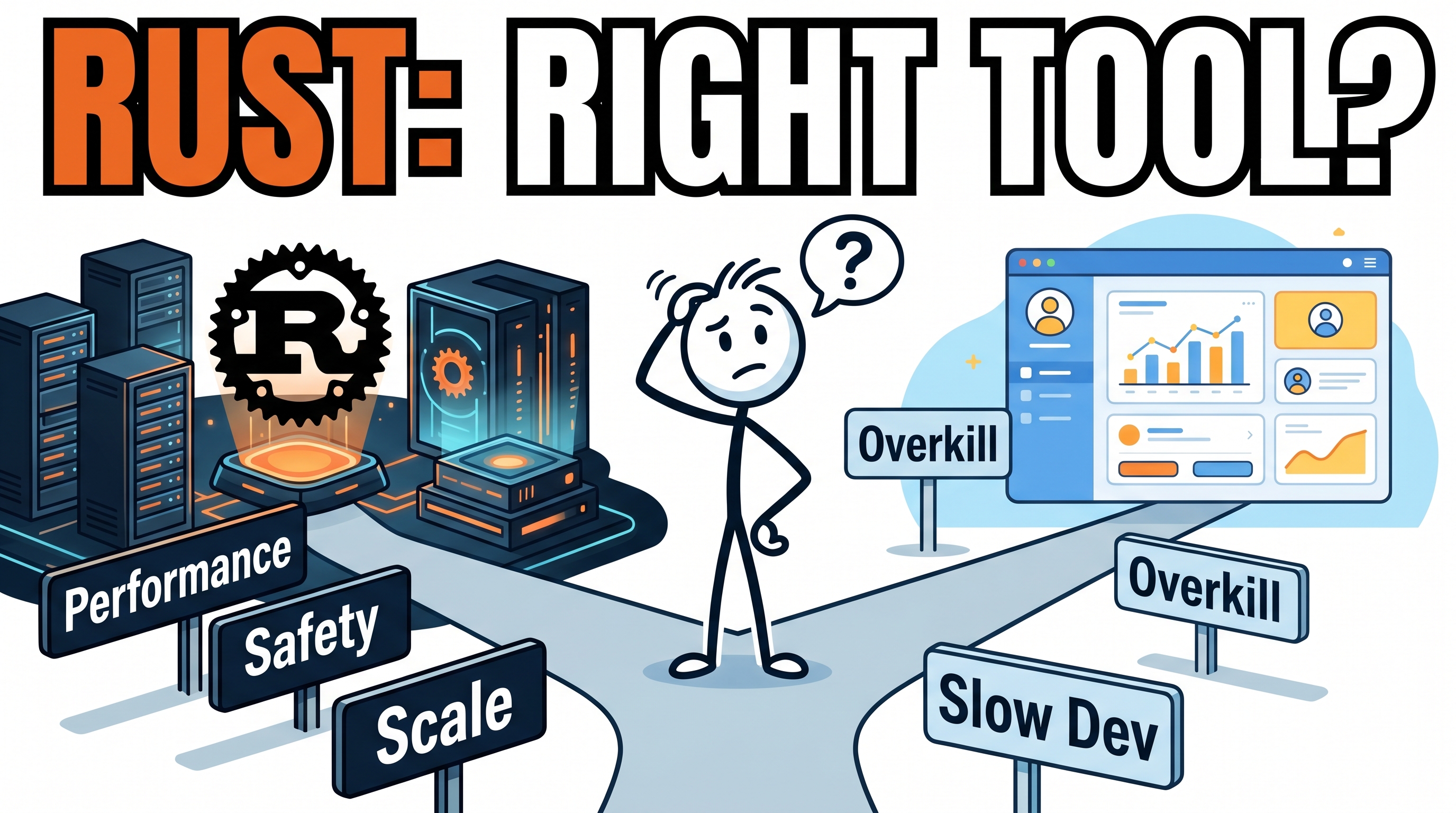
For internal dashboards, CRUD APIs, startup MVPs, and ordinary business software, the calculation changes.
Most backend applications are not CPU-bound. They are dominated by database latency, external APIs, business logic, and product iteration cycles. In those environments, developer velocity often matters more than squeezing maximum efficiency from the runtime.
This is where many teams struggle after adopting Rust too aggressively.
The language asks developers to think carefully about ownership, lifetimes, concurrency, and memory guarantees even when the application itself does not truly benefit from that complexity. The result can be slower onboarding, longer development cycles, and unnecessary friction for relatively standard software projects.
Senior engineers have become increasingly pragmatic about this distinction.
Using Rust for a payment processor handling enormous transaction volume makes sense. Using Rust for a basic admin dashboard with moderate traffic may not. The performance benefits often fail to justify the additional complexity.
That does not make Rust overhyped. It means the industry is finally separating infrastructure engineering from application engineering instead of pretending both problems require identical tools.
The Real Shift Is More Narrow — and More Permanent
Rust is not replacing every programming language.
It is replacing unsafe systems programming where safety failures are expensive.
That distinction matters because it explains both the excitement around the language and the high abandonment rate among developers who expected it to feel universally productive.
Rust succeeds precisely because it is difficult. The compiler forces discipline early so large systems remain stable later. In infrastructure environments, that tradeoff is incredibly valuable.
But the same constraints that protect critical systems can become unnecessary weight in fast-moving application development.
The software industry is slowly accepting that different layers of the stack deserve different priorities. Some projects optimize for iteration speed. Others optimize for long-term correctness under extreme scale.
Rust dominates the second category.
And that position alone may be enough to secure its future for decades.