Hermes Agent Feels Less Like a Chatbot and More Like a Long-Term AI Teammate
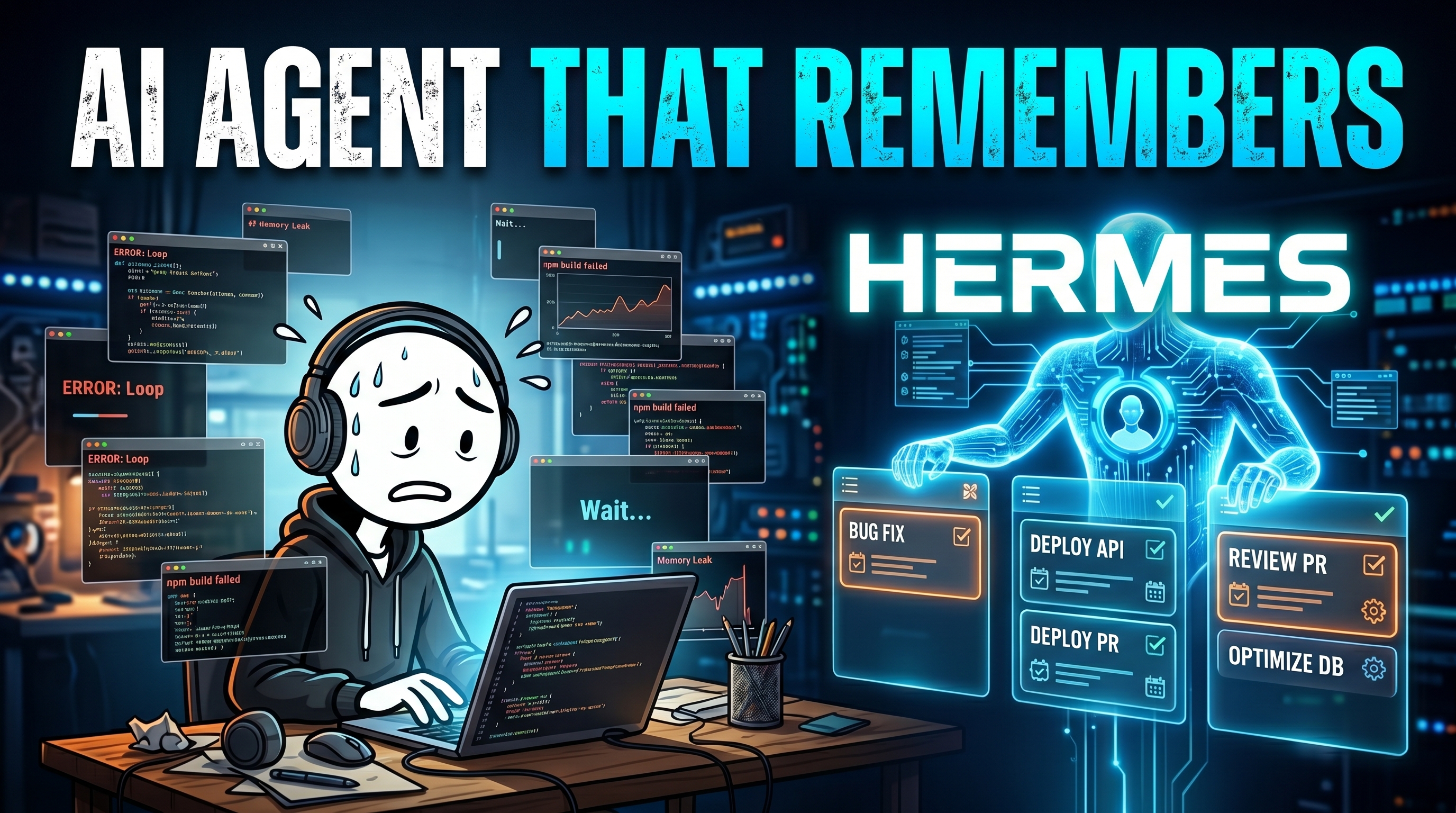
A few months ago, tools like Open Claw were everywhere in the AI developer space. The idea was exciting: autonomous agents that could execute tasks, remember context, and operate beyond a single chat window. But after the initial hype, the cracks started to show.
Security issues appeared frequently. Some agents behaved unpredictably. Community discussions became increasingly polarized between people treating these systems as production-ready and others warning they were still unstable experiments.
That’s why Hermes Agent immediately stood out when it appeared earlier this year.
What makes Hermes interesting is not that it can answer questions better than ChatGPT or generate cleaner code than another assistant. The important shift is architectural: Hermes is designed to behave more like a persistent operational system than a disposable conversation.
That changes how you use it.
Hermes Is Built Around Memory, Not Prompts
Most AI tools reset every time you open a new session. Even when they support “memory,” it usually feels shallow or temporary.
Hermes takes a different approach.
The system stores conversations, learns recurring workflows, and converts solved problems into reusable skills. Over time, it builds context around how you work instead of treating every interaction like a fresh start.
That distinction matters more than people realize.
A coding assistant helps you complete tasks inside an editor. Hermes is closer to an operational layer that sits around your work. You can interact with it through messaging platforms like Telegram while it continues running tasks remotely on a server.
For developers already juggling side projects, automation scripts, content pipelines, cloud infrastructure, or research workflows, this starts feeling less like a chatbot and more like delegation.
And honestly, that’s the first AI agent setup I’ve seen that feels sustainable beyond demos.
The Installation Is Surprisingly Straightforward
The actual setup process is refreshingly simple compared to many agent frameworks.
Hermes supports Linux, macOS, and WSL2 with a single install command that handles dependencies automatically.
That part is easy.
The more important decision is where you run it.
Hosting AI agents directly on your main machine is becoming increasingly risky. Persistent agents often require elevated permissions, API access, scheduled tasks, browser automation, and external integrations. Running all of that on your personal laptop is not ideal.
The smarter approach is isolating the environment entirely.
The original walkthrough recommends deploying Hermes on a VPS using a preconfigured Docker template. Whether you use that exact provider or not, the recommendation itself is solid. A lightweight cloud VM gives you:
- separation from your primary machine
- 24/7 uptime
- persistent memory storage
- easier scaling
- safer experimentation
For most developers, a small VPS is enough unless you’re running local inference or multiple autonomous workflows simultaneously.
Model Choice Matters More Than the Agent Itself
One thing newer users underestimate is how much the underlying model affects the quality of an AI agent.
Hermes itself is the orchestration layer. The reasoning quality still depends heavily on the model powering it.
The setup shown in the transcript highlights a few practical options:
- Claude Opus
- Gemini
- Qwen 3.6 Plus
- Owl Alpha through OpenRouter
What stood out to me was the recommendation around large context windows.
Once you start using persistent agents seriously, context length becomes incredibly important. Long-running task histories, memory accumulation, notes, workflow instructions, and skill libraries can balloon quickly. A model with a small context window starts degrading fast in these environments.
That’s one reason the newer generation of million-token context models feels noticeably better for agent systems than traditional chat assistants.
Not because they sound smarter in conversation, but because they maintain continuity over time.
Telegram Integration Is More Useful Than It Sounds
At first glance, connecting Hermes to Telegram feels gimmicky.
It isn’t.
Once the setup is complete through BotFather and the generated API token, Hermes becomes accessible from anywhere through a normal messaging interface.
That changes the interaction pattern entirely.
You stop “opening an AI tool” and start casually delegating things throughout the day.
You can send reminders, trigger workflows, update project context, ask for research summaries, or queue automation tasks without sitting in front of a development environment.
That convenience sounds minor until you actually live with it for a week.
Then it becomes hard to go back.
The Most Important Step Happens After Installation
Most people install these systems and immediately start testing prompts.
That’s usually the wrong move.
The transcript describes a process that I think is genuinely smart: begin with a complete operational context dump.
Not just your name and role.
Explain:
- what you work on
- your tooling stack
- recurring frustrations
- current projects
- communication style
- long-term goals
- repetitive workflows
- areas you avoid
- areas you care about deeply
This is where persistent agents separate themselves from chatbots.
You are not training a model in the machine learning sense. You are building usable operational context.
And the second step is even better: ask the agent how it thinks it could help you.
That sounds simple, but it surfaces automation opportunities many developers never notice on their own.
Good agents are often more valuable when identifying friction than when executing commands.
The Best Use Cases Are Boring
The flashy demos get attention, but the genuinely useful workflows are usually small and repetitive.
The examples from the transcript reflect that pretty well.
One setup sends a personalized morning briefing filtered around software engineering, AI tooling, and video production topics.
Another performs daily check-ins, tracks ongoing work, and occasionally suggests automation opportunities or relevant tools based on recurring patterns.
None of this sounds revolutionary.
That’s exactly why it works.
The strongest AI workflows today are not dramatic autonomous systems replacing entire jobs. They are low-friction systems removing tiny amounts of cognitive overhead repeatedly.
Developers tend to underestimate how much energy disappears into task switching, remembering context, re-explaining projects, or manually monitoring ecosystems.
Persistent agents are interesting because they reduce that overhead incrementally over time.
The Self-Improvement Loop Is the Real Differentiator
The feature that deserves more attention is Hermes’ ability to monitor community-built skills automatically.
Instead of remaining static, the agent periodically checks for new capabilities and recommends additions relevant to your workflow.
That’s important because most AI tooling today decays quickly. You install it, configure it once, and six months later the ecosystem has already moved on.
A system that continuously adapts without requiring manual maintenance is significantly more practical long term.
Especially in AI development, where tooling changes almost weekly.
The underlying idea is simple but powerful: the agent is not only learning from you — it is also updating itself against a broader ecosystem.
That creates compounding value over time.
Final Thoughts
Most AI products still feel transactional. You ask something, get a response, close the tab, and start over tomorrow.
Hermes is interesting because it breaks that pattern.
The value is not in any single conversation. It comes from accumulation: remembered context, refined workflows, reusable skills, recurring automation, and operational continuity.
That doesn’t mean it’s magic. It still depends heavily on model quality, infrastructure choices, security awareness, and how thoughtfully you configure it.
But compared to many recent AI agent projects, Hermes feels less like an experimental demo and more like a system designed for actual long-term use.
And right now, that’s a pretty rare thing in the AI tooling space.