7 Reasons Smart People Stay Average (And How to Break Free)
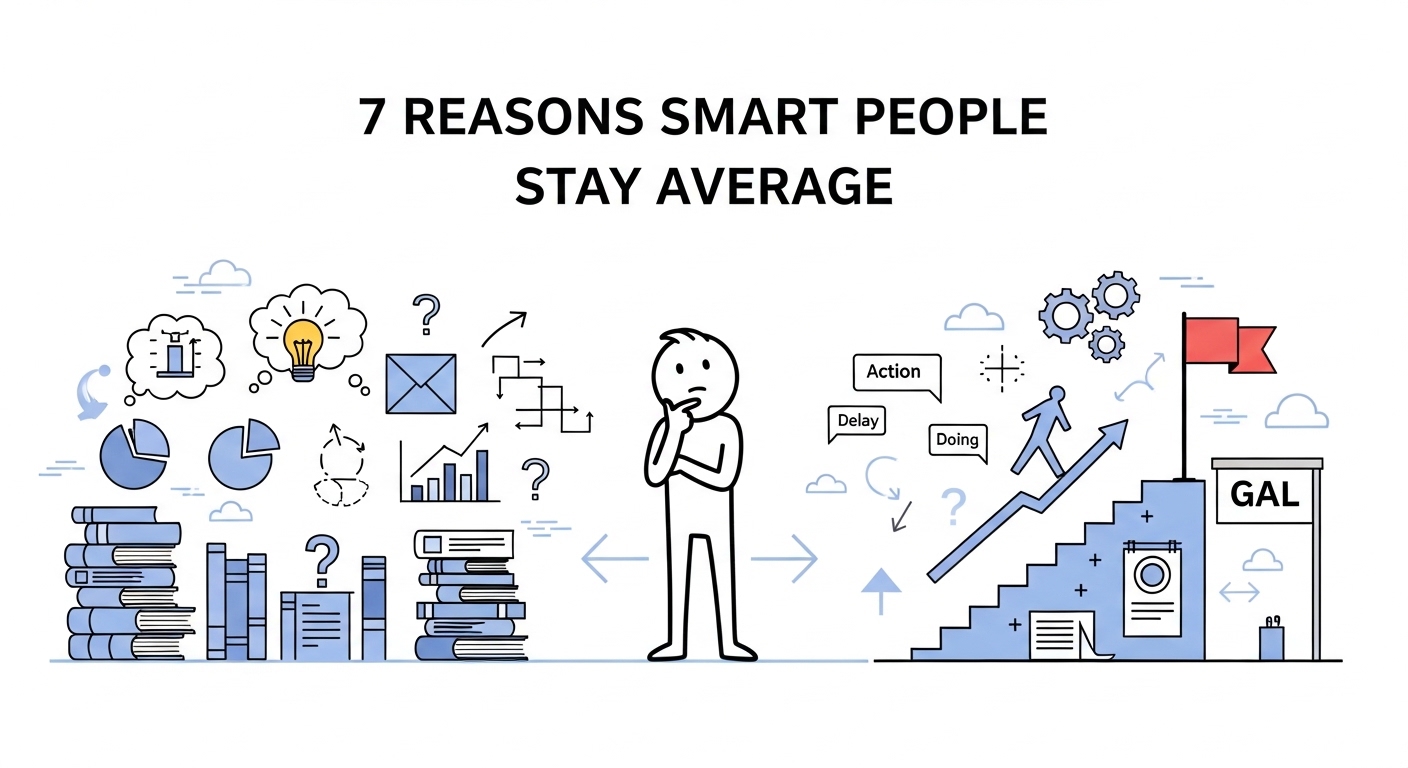
Being smart should help you win in life.
But sometimes, intelligence becomes the very thing that slows you down.
Smart people usually see risks early. They notice flaws quickly. They want to understand the full picture before they move. That sounds like an advantage, and in some situations it is. But in real life, overthinking often beats progress before progress even begins.
While one person is still trying to figure out the perfect move, someone else has already made an imperfect one and started learning from real experience.
That is why intelligence alone does not guarantee progress. In fact, many smart people stay stuck not because they lack ability, but because they fall into patterns that quietly hold them back.
1. They spend too much time understanding and not enough time doing
Smart people are often fast learners. They can absorb ideas quickly, connect patterns, and predict problems before others even notice them. That helps in school and in many jobs.
But there is a hidden trap in that strength: they begin to believe that understanding something is the same as making progress.
It is not.
A lot of intelligent people spend too much time reading, researching, planning, and comparing options. They want the best starting point. They want to avoid mistakes. They want clarity before action.
The problem is that real progress rarely works that way.
In most areas of life, clarity comes after action, not before it. You do not build confidence by thinking about confidence. You do not learn business by only consuming content about business. You do not become good at speaking, leading, creating, or selling by staying in your head.
At some point, you have to step into the real world and let action teach you what theory never can.
The person who starts with a messy plan often ends up ahead of the person still trying to design the perfect one.
2. They confuse being capable with being valuable
Many smart people grow up hearing the same things:
“You have so much potential.” “You’re talented.” “You’re naturally good at this.”
Over time, they start believing that being capable is enough. They assume life will reward them simply because they have ability.
But the world does not pay for potential. It rewards usefulness.
There is a big difference between being capable and being valuable. Being capable means you can do something. Being valuable means what you do helps other people in a clear and practical way.
That is why some people who seem less impressive on paper often move further ahead. They may not be the smartest in the room, but they know how to apply one useful skill in a way that solves real problems.
A smart person can know many things and still stay stuck if none of that knowledge becomes something practical, dependable, or worth paying for.
The better question is not, “Am I smart enough?”
The better question is, “What can I do that is clearly useful to other people?”
That shift changes everything.
3. They hate looking like beginners
A lot of smart people build their identity around being competent.
They are used to being the one who understands quickly, gives strong answers, and looks capable in front of others. After a while, that image becomes something they feel they need to protect.
And that becomes a problem.
Growth usually starts with being bad at something.
When you try something new, you ask simple questions. You make obvious mistakes. You feel awkward. You move slower than people who have done it before. That is not failure. That is the beginner stage.
But many smart people resist that stage because it makes them feel exposed. They do not want to look unsure. They do not want to ask the basic question. They do not want to fail in public.
So they stay in areas where they already look polished.
They keep doing what they are already good at, and because of that, they keep getting the same level of results.
If you always need to look smart, you will keep choosing what is familiar. And familiar choices usually create familiar outcomes.
4. They care too much about being right
Smart people are often excellent at spotting what is wrong.
They can tell why an idea might fail, why a plan is weak, or why a system will break long before it actually does. That skill is useful, but it can become a trap.
Life does not always reward the person with the most correct opinion. It often rewards the person who acts, adjusts, and keeps going.
Some people become so attached to being right that they never develop the ability to execute in messy conditions. They become strong at critique but weak at movement.
The truth is simple: being right in your mind is not the same as making progress in real life.
Someone can have a perfect opinion about business and still never build one. Someone can understand fitness deeply and still stay out of shape. Someone can give excellent advice and still have very little to show for it.
Action is uncomfortable because it creates uncertainty. Once you act, your idea can fail. Your plan can look weak. You can be wrong in public.
That is why some smart people stay in analysis mode. It feels safer there. Their intelligence still looks impressive, and nothing is tested.
But progress begins when judgment turns into action.
5. They stay in places where intelligence gets noticed, but not rewarded
Praise can feel like progress, but they are not the same thing.
You can be the smartest person in the room and still build very little if that room rewards talking more than doing. Some environments admire intelligence, but do not push people toward output, ownership, or real value.
In those spaces, smart people can become known for having good ideas, sharp opinions, or quick thinking, but their life does not really move forward.
This can happen in school, at work, online, or even in social circles.
If the reward system is mostly social, being admired, sounding sharp, getting attention for your thoughts, it becomes easy to mistake recognition for growth.
You feel ahead, but your results do not change.
That is why it is important to ask not only where you are appreciated, but where you are challenged. Not only where you are seen, but where your strengths are being turned into something real.
6. They optimize too early
This is one of the most common traps smart people fall into.
Someone wants to start a business, but instead of testing the idea, they spend weeks working on branding, websites, and detailed plans.
Someone wants to get fit, but instead of training, they spend days comparing programs, supplements, apps, and routines.
Someone wants to create content, but gets stuck choosing the perfect camera, name, style, or strategy before publishing anything.
This is early optimization.
It is trying to improve step ten while still standing at step one.
Smart people often do this because they hate waste. They do not want to make the wrong move if there might be a better one. So they keep polishing things that have not even been tested in reality yet.
But that only creates the illusion of progress.
In most cases, the person who starts with something simple and improves over time will beat the person who keeps designing the perfect beginning.
You cannot optimize what has not been proven yet. First make it real. Then make it better.
7. They underestimate how much courage matters
Many of the biggest moves in life do not require exceptional intelligence.
They require courage.
Starting something new. Speaking up. Changing direction. Leaving a safe place. Publishing your work. Asking for more. Taking a risk before you feel fully ready.
All of that is driven more by courage than by intelligence.
Smart people often see too many possible problems. They can imagine what might go wrong before anything has even started. So they wait. They want better timing, more proof, more confidence, or one more sign that the move is safe.
But certainty often never comes.
Meanwhile, someone less analytical but more willing to act takes the chance.
And very often, that person moves further ahead.
This does not mean intelligence is useless. Of course it helps. But intelligence alone cannot remove discomfort. It cannot make risk disappear. It cannot replace courage.
At some point, life stops asking whether you understand the situation.
It starts asking whether you are willing to move anyway.
Final thought
A smart mind is a gift, but it can also become a hiding place.
It can keep you researching instead of starting. Planning instead of building. Critiquing instead of trying. Waiting instead of moving.
That is why so many intelligent people stay stuck in average lives. Not because they lack ability, but because they keep using that ability to delay the hard part: action.
The people who move forward are not always the smartest.
They are often the ones who can begin before they feel ready, learn while doing, and keep going even when they feel uncertain.
In the end, life rarely rewards potential by itself.
It rewards action, usefulness, and courage.