4 Habits That Separate Great Developers From Average Ones
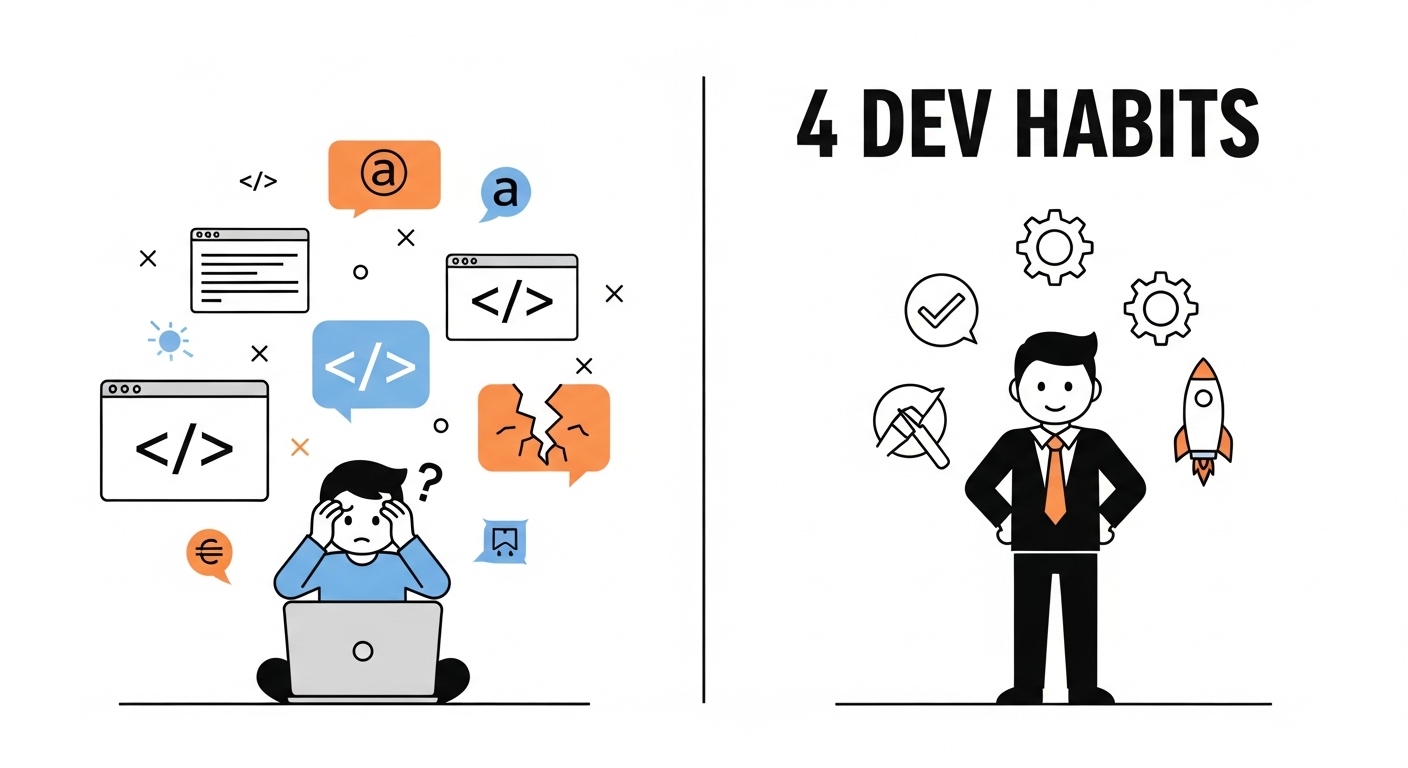
A lot of developers are chasing the wrong things.
They collect programming languages like trophies. They jump to a new framework every few months because someone online said the old one is finished. They spend hours solving coding interview problems they will forget a few days later, just to get into companies they may not even care about.
It looks productive. But most of the time, it is not helping them become truly great developers.
The difference between average developers and top developers is usually not talent.
It is habits.
Not flashy habits. Not exciting habits. Just simple, repeatable actions that build skill over time.
Here are four habits that separate strong developers from everyone else.
1. Great developers build consistently
This sounds obvious, but many people still avoid it.
A lot of developers wait for the perfect moment to start. They wait until they finish one more course. They wait until they feel more confident. They wait until they have the right idea, the right stack, or the perfect project plan.
That moment rarely comes.
Strong developers build anyway.
They open their laptop and start with what they have. They know the result may be messy. They know the first version may be ugly, incomplete, or broken. But they do it anyway, and then they come back the next day and do it again.
This is how real progress happens.
Almost every excellent developer has a long list of unfinished projects, failed experiments, abandoned tools, and ideas that never worked out. From the outside, those projects may look useless. In reality, they were training.
Each project taught them something practical: how to debug, how to structure code, how to recover from mistakes, how to make better decisions next time.
You do not become good at building software by watching other people build it.
You become good by building things yourself — badly at first, then better over time.
2. They explore new technology without getting distracted by it
This is where many developers lose focus.
Whenever a new tool, framework, or trend appears, most people go to one of two extremes.
One group rushes toward it immediately. They treat every new release like a must-learn opportunity. They keep switching stacks, constantly restarting, never staying with one thing long enough to gain depth.
The other group ignores everything new. They assume what they already know is enough. They avoid learning until the technology becomes unavoidable — usually when their team adopts it and they suddenly have to catch up under pressure.
Neither approach works well.
The best developers do something more balanced.
They stay curious, but they stay grounded.
When something new appears, they do not blindly commit months of their life to it. They also do not reject it without trying it. They test it in a small way. They build something simple. They get direct experience. Then they decide whether it matters.
That is a much smarter way to stay current.
Top developers are not chasing every trend. But they are also not the ones who refuse to adapt until everyone else has moved on.
They learn enough to form real opinions, not borrowed opinions.
That balance is a skill by itself.
3. They do not stop at answers that work. They look for answers that make sense
This habit matters more than most people realize.
When developers do not understand something, the common reaction is predictable.
Some search online, copy the first solution that works, and move on.
Some ask a coworker, get an answer, and forget it soon after.
Others avoid the problem entirely and hope it never becomes important.
But unclear things have a way of returning later — usually when the system is bigger, the pressure is higher, and the mistake is more expensive.
Strong developers respond differently.
They go deeper.
They read the documentation. They check the official source. They try to understand the underlying concept, not just the shortcut. If necessary, they look at the implementation itself.
Their goal is not only to fix the issue.
Their goal is to understand why the fix works.
That difference compounds over time.
A developer who repeats this habit for years becomes the person who can walk into an unfamiliar codebase and actually understand what is happening. They do not rely on luck, trial and error, or copy-paste solutions.
They can reason through systems with confidence.
That kind of understanding is built slowly, one question at a time.
4. They learn with intention
Many developers are always “learning,” but not moving forward in a meaningful way.
They jump from one course to another. One tutorial series to the next. One productivity wave to another. It feels like progress because there is always motion.
But motion is not the same as growth.
Top developers are much more deliberate.
They pay attention to their weak spots. They notice the concepts they keep avoiding. They identify the topics they pretend to understand in meetings but cannot explain clearly on their own.
Then they work on those gaps directly.
Instead of endlessly consuming general content, they focus on the next thing that actually matters for their development.
They study it until they understand it well enough to explain it simply.
Then they move on to the next gap.
That cycle is powerful: identify weakness, study deeply, practice, understand clearly, repeat.
Over time, that process turns someone from merely capable into someone exceptional.
Not in 30 days. Not because of one course. Not because of one certificate.
But across years of consistent effort.
Greatness in development is less dramatic than people think
None of these habits are complicated.
They do not require genius. They do not require perfect conditions. They do not require being the smartest person in the room.
They require consistency.
And that is exactly why they are so powerful.
Most people stop when things become uncomfortable. They stop when the project gets messy, when the documentation is difficult, when the new concept feels confusing, or when learning becomes slow and repetitive.
The best developers keep going.
That is the real difference.
The top level of software development is not reserved for a small group of naturally gifted people. It is not a private club.
It is a direction.
And every day, every developer is either moving closer to it or farther away based on what they choose to do.
Build something. Understand something. Stay curious. Then repeat.
That is how great developers are made.